
Neighborhoods
Riverwalk: Housing, Public Trails, and Community Research
The trail is public. Most of the river frontage is not for sale.
Published September 8, 2026
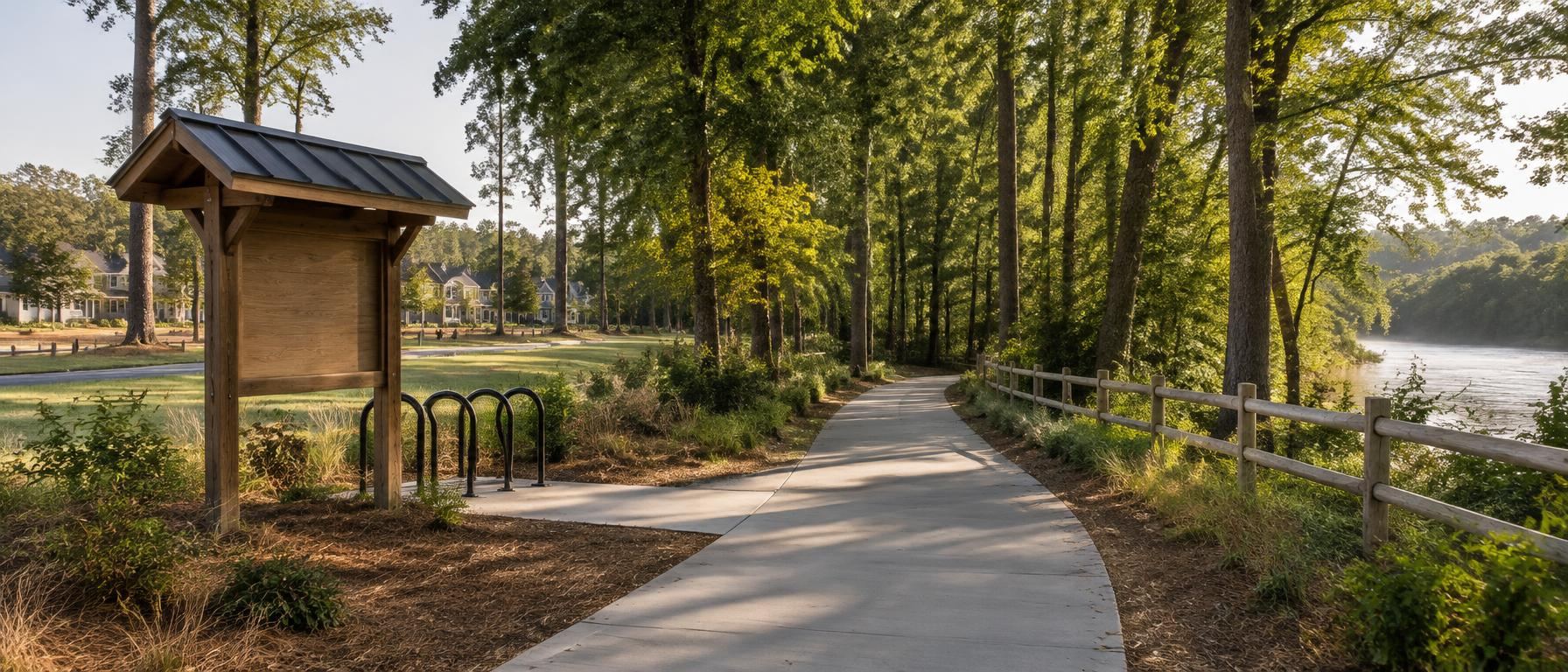
Separate the two
Riverwalk's trail and velodrome are public draws; its homes, pools, and amenity spaces are generally governed by HOAs. Research the home and the recreation separately.
Is Riverwalk Rock Hill, SC Public or Private?
Riverwalk in Rock Hill, SC is both: the river trail and Giordana Velodrome are public recreation draws, while homes, pools, and many amenity spaces are private and governed through HOA documents.
That distinction is the main research point. A buyer should not assume that living near a public trail creates rights to every nearby amenity, and a visitor should not assume that residential areas are part of the public recreation system. Treat Riverwalk as overlapping layers: public access, private ownership, HOA governance, and property-specific boundaries.
What Public Access Actually Means
Public access means the public may use designated recreation areas under the rules set for those facilities. It does not mean the surrounding residential land is open, and it does not make private community amenities available to trail users. Before planning a visit, check current facility rules, posted access points, and any event-specific restrictions for the trail or velodrome.
For home research, public access cuts both ways. It can be a daily lifestyle benefit if the walking route from the home to the trail is convenient. It can also bring visitor activity near certain points. The right question is not simply whether the trail is nearby, but how the specific property relates to public movement.
- Find the nearest designated trail access point.
- Walk the route from the home, not just the map.
- Check posted rules for public recreation areas.
- Ask where visitors typically park.
- Confirm whether any nearby space is private HOA property.
How to Verify River Proximity Claims
In Riverwalk, river proximity usually means access to the Catawba River setting, not ownership of river frontage. Listing language can blur that difference, so verify it with documents rather than adjectives. A home can feel connected to the river by trail access and still have no lot boundary touching the water.
Ask for the recorded plat, review the parcel in York County GIS, and look for any common area, easement, buffer, or conservation restriction between the lot and the river. If the word “frontage” matters to your purchase, it must be supported by the property boundary, not by a view, a path, or marketing photos.
- Does the lot boundary touch the river?
- Is common area between the home and water?
- Are buffers or easements shown on the plat?
- Is any area mapped as floodplain?
- Do HOA rules limit exterior changes near the bank?
- Does the listing say near, view, or frontage?
Questions for HOA Document Review
Riverwalk was planned and built in phases, so do not assume every home follows the same rules. A single-family home, townhome, or apartment setting may involve different documents, different maintenance responsibilities, and different expectations for exterior changes. Read the actual covenants for the property under consideration.
HOA review is not just about dues. It affects how owners use outdoor space, whether rentals are limited, how vehicles and trailers are handled, and what approvals are needed before adding fences, pools, outdoor kitchens, or other improvements. A local real estate agent can help request documents, but the buyer should still read them before relying on a lifestyle assumption.
- Which HOA or sub-association applies?
- What amenities are included for this property?
- What exterior changes require approval?
- Are rentals or short-term rentals restricted?
- How are fences, pools, and outdoor kitchens handled?
- Are there planned assessments or reserve concerns?
City Limits, Services, and Address Checks
A Rock Hill, SC mailing address does not by itself prove that a property is inside City of Rock Hill limits. That matters because city limits affect taxes, zoning, police, sanitation, utilities, and permitting authority. Riverwalk research should always include jurisdiction before any offer is treated as complete.
Use the parcel, not the ZIP code, as the starting point. Check York County GIS, confirm with the City of Rock Hill when needed, review the tax bill for city millage, and identify the utility providers for the exact address. If schools are part of the decision, confirm assignment by property address with the applicable district rather than relying on assumptions.
Planning a Home Visit Around the Trail
A showing in Riverwalk should include more than the home. Build time to walk the surrounding streets, locate the practical trail route, and observe how public recreation and private residential life meet. Visit the access point you would actually use, not only the most attractive section shown in photos.
Look for daily friction points. Is the route comfortable with children, bikes, or guests? Are there busy crossings or areas that feel separated from the home? Does the property sit near public activity, or is the recreation close enough to enjoy without feeling immediate? These observations help translate “near the trail” into lived reality.
Riverwalk Compared with Lake Wylie
Riverwalk and Lake Wylie are different water settings, and the research questions are different. Riverwalk is tied to a moving Catawba River setting with public trail access and limited true river frontage. Lake Wylie is a reservoir setting where waterfront ownership, dock permits, shoreline rules, and water depth become central questions.
Do not use the same checklist for both. For Riverwalk, focus on HOA documents, trail access, parcel boundaries, floodplain questions, and public-versus-private spaces. For Lake Wylie, the dock, shoreline, and reservoir rules require separate verification. If a property description mixes river, lake, trail, and waterfront language, slow down and define each term before comparing homes.
Our network
Your Next Chapter
Discuss specific Riverwalk homes with a local agent.
These websites are affiliated with Rock Hill Living. See the full network or find the right team for your project.